apocalypse-puppy

A record of thoughts about teaching, writing, and living the academic life.

Showing posts with label apocalyptic. Show all posts

Friday, November 9, 2012

My Apocalyptic Autobiography

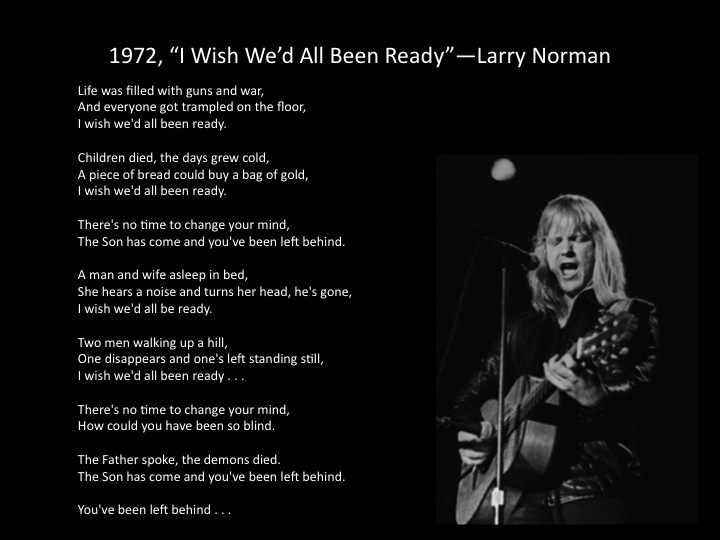
I was asked (OK, maybe I volunteered) to talk about apocalyptic in a colleague's class on Christian Traditions.  I decided to approach the topic through the lens of my experience growing up in an evangelical Christian context, surrounded by apocalyptic and millenarian thinking and conversations. Here are some pieces of that presentation.


The picture on the left is my mom and me (it's actually probably 1973, but that's as close as I could come). My mom, one of the first college graduates in her family and an elementary school librarian, was a very observant Christian.  She was always interested in learning more about the Bible.  One of the topics that interested her was apocalyptic prophecy, so Hal Lindsey's books were part of our home library.  Although my mother didn't embrace millenarian thinking entirely, conversations about eschatology were familiar in our home and within our family.  In particular, my grandfather, a Russian immigrant, believed that the tribulation had begun in Stalinist Russian.


Like so many kids growing up in the 1970's and 1980's in an evangelical context, I was exposed to apocalyptic rhetoric in various settings, including camp meetings, church youth group, Bible study, etc. I remember attending a beach retreat when I was in grade school (probably about 5th grade) with my youth group and screening "A Thief in the Night" after a full day of fun at the beach. What a way to end a day of fun . . . with a good dose of apocalyptic horror.  (Here's a link to a great article about the 40th anniversary of the move.)


I was a very earnest kid.  In fact, probably too earnest, too serious.  And, beginning in the 4th or 5th grade I began having uncontrollable panic attacks, occasions in which I would experience a range of different symptoms, including rapid heart-beat and breathing, a sense of dread, sweats, nervousness, shaking, lowered blood pressure, nausea, faintness, blurred vision, ringing in my ears.  These panic attacks often would lead to fainting.  While I wouldn't link these panic attacks and the depression that accompanied them to the apocalyptic rhetoric that surrounded me, the fear of being "left behind" and not being "right with God" surely did not help my situation. (Watching films was  a trigger for my panic attacks and for a number of years I was excused from watching movies at school for fear that I would faint.)

In 1988, I was very involved with my church, working as a camp counselor for various congregations in our denomination. During this time, a number of people around me began to circulate the little booklet "88 Reasons Why the Rapture Could Be in 1988." While I had some doubts about the book, a part of me believed that it could be true.  I was worried and anxious and . . . I was about to start my first year in college.


This is a picture of me standing by the car that I would take with me to college.  My first week of school corresponded to the week that was supposed to be the end.  I remember be nervous about being away from home, away from my family.  I was confused about why God might choose this particular time in history.  Fact is, I wanted to go to college.  I wanted to experience being away from home.


FYI, the rapture didn't happen in 1988.  

I wasn't disappointed.

But, I did have to rethink my tradition and my understanding of the Bible.

Eventually, when I started a graduate program in New Testament studies, I was not interested in studying Revelation.  I didn't want to touch the book with a 10 foot pole.  I was actually concerned that it might give me panic attacks.  However, after taking a seminar on the text, a seminar which allowed me to think about the text in its historical context, I became fascinated with its imagery.  I became passionate about exploring how a text from the first-century, ostensibly written as a critique of the Roman Empire, could continue to capture the imaginations of readers throughout history.  Why is Revelation so compelling?  How has this poorly written Greek text managed to capture the imaginations of readers throughout history?

My answer begins here: It's the imagery, and the text's ability to conjure the audience's visual imagination.  Among other things of course . . . 


Wednesday, June 23, 2010

thinking about next steps: material culture and the NT


I'm currently in the midst of what I'll call a research/ writing gap. I just finished a draft of chapter for my current project and I need to move on to the next chapter. I'd like to start this chapter now, however, I'm going to be traveling for a couple of weeks. I'll be on a research trip to Israel and Jordan where I'll be working on a project related to my teaching and not a project related to my writing. Unfortunately, I'm not quite sure how to navigate this gap. I took a couple days to write a book review, but now that's completed and I am at loose ends again . . .

Maybe this is a good time to sit back and think about what I want out of the research trip. The program requires that each participant have a project that relates to the trip, which focuses on the area ruled by the Herodian dynasty during the Roman and Late Antique periods. It would be nice to have something publishable out of this, in fact.

I have proposed a project related to teaching the NT through material culture. I have articulated two specific foci within this broad topic.

The first set of research questions is related to a course I am currently developing entitled “Messiahs and Martyrs.” This course is intended to replace and improve upon a catalog course on “Jesus and the Gospels,” by offering an examination of first-century Messianic movements, an understanding that situates written texts within their historical and material milieu. The course will naturally address issues related to the Qumran community, as well as the controversies surrounding the events at Massada; however, it will also attend to the presence of the Roman Empire within Galilee and Jerusalem as way of encouraging students to think about Messianic movements as responses to other political/ religious/ social discourses. In particular, I am curious about the ways in which people living within the Herodian period may have imitated and appropriated aspects of Roman and/ or Hellenistic culture.

The second set of questions involves the ways in which gender, masculine and feminine, is regulated and represented in ancient Judea/ Galilee. I am curious to see the ways that space may have reflected gender norms and how images may or may not have been used to communicate particular gender ideals. I would try to think about the ways that this is similar to or different from what we see in Roman Italy. Additionally, I would be looking for visual clues to how people might have embraced and resisted such ideals. These types of questions would be incorporated into both my future research on gender in the ancient world and in my teaching, specifically a course I teach on gender, sex and family in early Christianity.

In addition to using material culture to explore these questions, I plan on working on a digital archive of images for teaching. In order to receive funding from my institution, I needed to put together a proposal related to my work in the classroom. Since I use images to teach, this seemed like a natural project.

My question in a nutshell is how material culture can be used to engage students in critical thinking about apocalyptic movements and gender construction?