apocalypse-puppy

A record of thoughts about teaching, writing, and living the academic life.

Showing posts with label rapture. Show all posts

Friday, November 9, 2012

My Apocalyptic Autobiography

I was asked (OK, maybe I volunteered) to talk about apocalyptic in a colleague's class on Christian Traditions.  I decided to approach the topic through the lens of my experience growing up in an evangelical Christian context, surrounded by apocalyptic and millenarian thinking and conversations. Here are some pieces of that presentation.


The picture on the left is my mom and me (it's actually probably 1973, but that's as close as I could come). My mom, one of the first college graduates in her family and an elementary school librarian, was a very observant Christian.  She was always interested in learning more about the Bible.  One of the topics that interested her was apocalyptic prophecy, so Hal Lindsey's books were part of our home library.  Although my mother didn't embrace millenarian thinking entirely, conversations about eschatology were familiar in our home and within our family.  In particular, my grandfather, a Russian immigrant, believed that the tribulation had begun in Stalinist Russian.


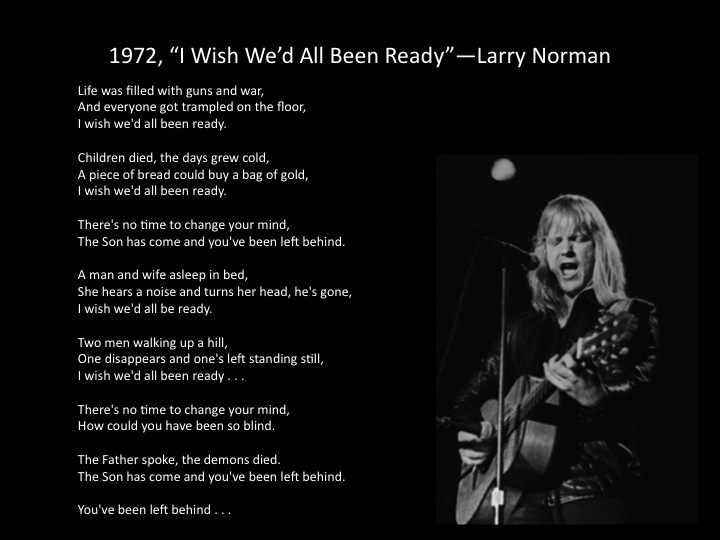
Like so many kids growing up in the 1970's and 1980's in an evangelical context, I was exposed to apocalyptic rhetoric in various settings, including camp meetings, church youth group, Bible study, etc. I remember attending a beach retreat when I was in grade school (probably about 5th grade) with my youth group and screening "A Thief in the Night" after a full day of fun at the beach. What a way to end a day of fun . . . with a good dose of apocalyptic horror.  (Here's a link to a great article about the 40th anniversary of the move.)


I was a very earnest kid.  In fact, probably too earnest, too serious.  And, beginning in the 4th or 5th grade I began having uncontrollable panic attacks, occasions in which I would experience a range of different symptoms, including rapid heart-beat and breathing, a sense of dread, sweats, nervousness, shaking, lowered blood pressure, nausea, faintness, blurred vision, ringing in my ears.  These panic attacks often would lead to fainting.  While I wouldn't link these panic attacks and the depression that accompanied them to the apocalyptic rhetoric that surrounded me, the fear of being "left behind" and not being "right with God" surely did not help my situation. (Watching films was  a trigger for my panic attacks and for a number of years I was excused from watching movies at school for fear that I would faint.)

In 1988, I was very involved with my church, working as a camp counselor for various congregations in our denomination. During this time, a number of people around me began to circulate the little booklet "88 Reasons Why the Rapture Could Be in 1988." While I had some doubts about the book, a part of me believed that it could be true.  I was worried and anxious and . . . I was about to start my first year in college.


This is a picture of me standing by the car that I would take with me to college.  My first week of school corresponded to the week that was supposed to be the end.  I remember be nervous about being away from home, away from my family.  I was confused about why God might choose this particular time in history.  Fact is, I wanted to go to college.  I wanted to experience being away from home.


FYI, the rapture didn't happen in 1988.  

I wasn't disappointed.

But, I did have to rethink my tradition and my understanding of the Bible.

Eventually, when I started a graduate program in New Testament studies, I was not interested in studying Revelation.  I didn't want to touch the book with a 10 foot pole.  I was actually concerned that it might give me panic attacks.  However, after taking a seminar on the text, a seminar which allowed me to think about the text in its historical context, I became fascinated with its imagery.  I became passionate about exploring how a text from the first-century, ostensibly written as a critique of the Roman Empire, could continue to capture the imaginations of readers throughout history.  Why is Revelation so compelling?  How has this poorly written Greek text managed to capture the imaginations of readers throughout history?

My answer begins here: It's the imagery, and the text's ability to conjure the audience's visual imagination.  Among other things of course . . . 


Tuesday, September 14, 2010

Obsessing over Revelation

A person I knew in grad school had a little game she liked to play . . . connecting people's dissertation topics to their "issues." Her theory was, we often use our dissertations to work out emotional issues, rather than strictly academic issues and questions, even if it is not intentional. I had a dissertation topic that seemed to prove the point, for in the midst of writing my dissertation on Revelation's bridal and nuptial imagery I went through a painful divorce that involved my questioning of issues pertaining to gender and marriage in general. While at the time I nodded along and agreed with her assessment, today I look at the connection differently . . . I was attracted to my topic not because of the bridal or nuptial piece, but because of the Book of Revelation and how it relates to the way I think and look at the world. Scary, I know!

When I teach my apocalyptic literature class, I often show my students a picture of myself getting ready to drive off to college. I'm leaning against my car (which I would total a couple years later) and I look happy. I tell my students that what they can't see is the effect Revelation has had on me. At that time, August 1988, I was pretty consumed with anxiety. I had spent the summer working for my church denomination, leading children's camps. A group of people that I encountered that summer had become advocates of a booklet entitled "88 Reasons Why the Rapture Could Be in 1988." While the title used the word "could," the text aimed to convince the reader that the Rapture would most definitely happen in the fall of 1988. It used biblical passages, especially drawn from Daniel and Revelation, to make its point. Of course it hedged on pinpointing a precise date, because as all good evangelical Christians know, "No one knows the day or the hour." The week, however, we can guesstimate.

Given my encounter with "88 Reasons," I started college especially anxious. I didn't completely buy into the Rapture-fever-excitement, but I had always lived with the fear of impending judgment. I had spent my days trying to live a perfect life and I spent the moments before I fell asleep praying for forgiveness even for "sins" that I may have unintentionally committed. Years later I would realize that this fear of unintentional sinning is part of obsessional thinking, something that many people with obsessive personalities do. (Unsurprisingly, there are many of us in academia!) The "88 Reasons" booklet fed into this, giving me something else to worry about. What if the authors were right? Then I was really screwed.

The week of the supposed Rapture came and went, obviously. But, I had other things to deal with as first year student, like dealing with a crazy roommate and picking a major. The roommate situation remained a little unsettled, but I happily settled into a philosophy major. And, while the philosophy major made me rethink religion, Revelation and the Rapture, I wasn't able to shake the obsessive thinking. At least the impending end of the world was no longer an issue. I no longer imagined myself under God's judgmental eye or under the eye of a Christ-coming-in-the-clouds; instead, I had internalized that eye in a different way.

It wasn't until graduate school that I had to reconsider Revelation. It wasn't my choice, but Revelation was the only option for a New Testament seminar one semester. I approached it with some trepidation, but to my surprise I was intrigued with the text. I was reminded of the text's rhetorical power and I was fascinated by the way it used imagery to further its rhetorical ends. I was also reminded of its power over me, through the guise of "88 Reasons." I was a relatively intelligent high-school and college student, why had the book gotten under my skin and made me so anxious? As I thought about my dissertation, I thought I would explore how the text's imagery, its metaphorical language, worked to persuade and to shape thought. The text, I thought, had some power to persuade reasonably intelligent individuals to think in apocalyptic ways.

While I still afford Revelation's metaphor a certain amount of rhetorical power, I am beginning to think more and more that my own thought patterns were part of what attracted me to Revelation. My tendency toward dualistic and somewhat extreme thinking means that Revelation made some sense to me. I resonated with the text. Of course, I bought into the idea of an impending judgment . . . I had been anticipating it for years in my tendency toward self-judgement and criticism. I guess I think it is a cultural cycle of sorts: Revelation and other apocalyptic texts and traditions create a culture that tends toward absolutes, dichotomies, notions of judgment. Those of us who are prone to these ways of thinking buy into and potentially perpetuate the text's apocalyptic thought patterns. On one hand my scholarship tries to disarm the text of this power. If we know how the text's metaphors work, maybe we can resist them and not be bowled over. On the other hand, I wonder if or how my scholarship perpetuates these patterns.